Harmo Brain Ingredients: Six Named Materials in One Daily Capsule
Quick answer
The Harmo Brain label lists six materials in a 575 mg proprietary blend: magnesium glycinate, alpha lipoic acid, butcher’s broom root extract, L-carnitine, turmeric rhizome extract standardised to 95% curcuminoids, and CoQ10 as ubiquinone. Magnesium is declared at 80 mg a capsule, 19% of the Daily Value. The capsule shell is vegetable hypromellose.
Below: each ingredient’s role and research, the label order, and what studies used.
One capsule is one serving and a bottle holds 30, so every figure here is a daily figure.
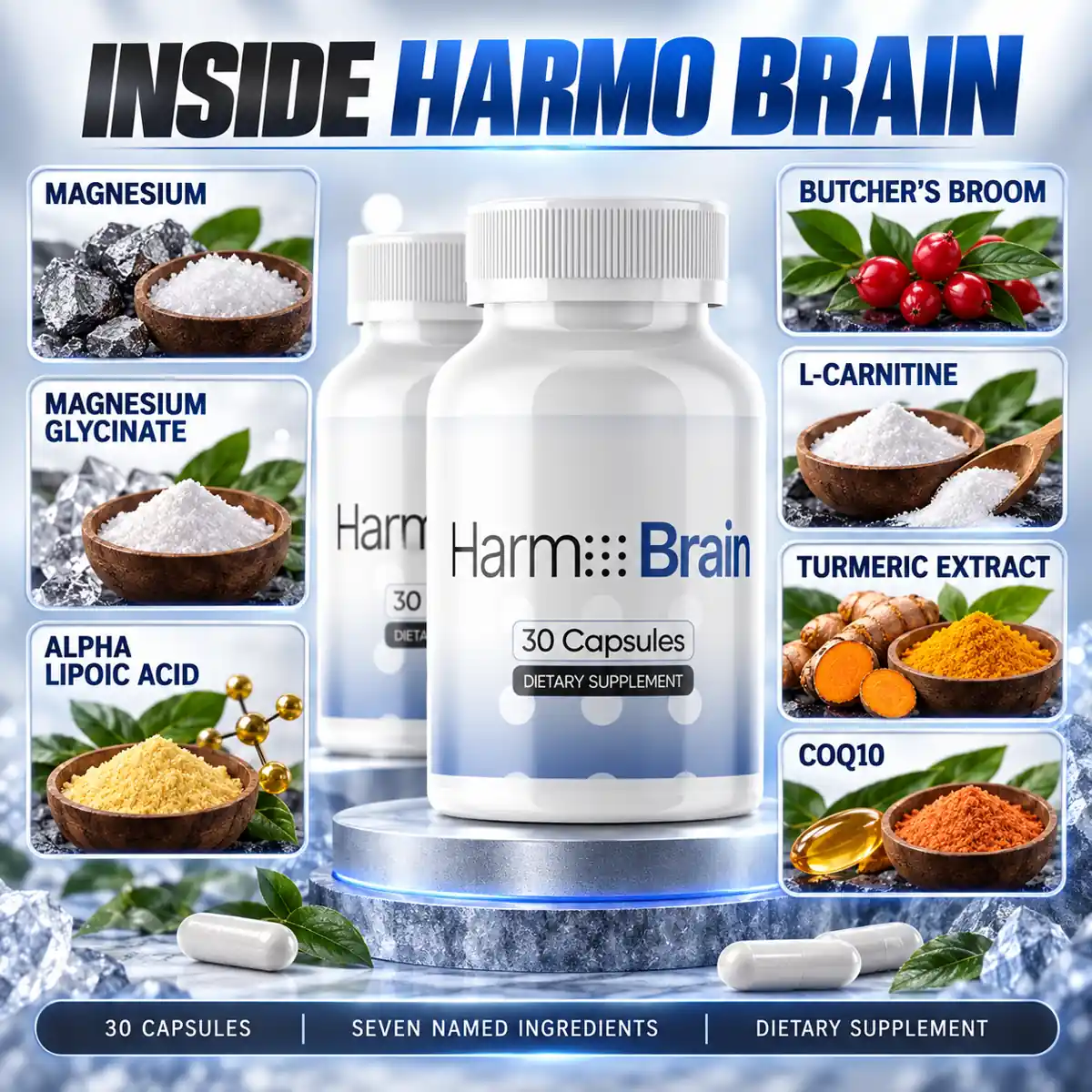
The supplier’s “Inside Harmo Brain” artwork The tiles run in the same order as the label panel, from the mineral down to CoQ10. The artwork carries no amounts; the 80 mg and 575 mg figures are on the label, set out below.
The short version
Harmo Brain ingredients at a glance
Harmo Brain ingredients: the facts on the label
Serving
1 capsule. The label: take one capsule daily.
Per bottle
30 capsules, 30 servings, so one bottle is one month
Declared amount
Magnesium 80 mg, 19% of the Daily Value, as magnesium glycinate
Each card carries the amount the panel prints, the job the ingredient does in the body, what the research found and the caution that travels with it. The two forms of carnitine are compared in L-carnitine or acetyl-L-carnitine.
Mineral
Magnesium glycinate
80 mg magnesium · 19% DV
An essential mineral, carried as a glycine chelate
Magnesium is a cofactor in more than 300 enzyme systems, including those behind nerve and muscle function. A 2024 systematic review found the trials too few to judge supplements for cognition; cohort data tie both low and high blood levels to worse outcomes.
Separate it from oral bisphosphonates and from tetracycline or quinolone antibiotics, which magnesium can bind.
A cofactor of the mitochondrial enzymes that turn fuel into energy
Lipoic acid is a cofactor for several mitochondrial multienzyme complexes and forms a redox couple with dihydrolipoic acid. Its best-studied human use is diabetic neuropathy, where 600 mg a day given intravenously for three weeks eased symptoms.
The Linus Pauling Institute notes a risk of low blood sugar in people using insulin or oral diabetes medicine, and case reports tie lipoic acid to insulin autoimmune syndrome, a rare cause of low blood sugar.
A venotonic herb, the circulatory half of the formula
Its trials are in leg veins, not in the brain: a placebo-controlled trial in 166 women with chronic venous insufficiency, and a meta-analysis of the Cyclo 3 Fort combination across 10,246 subjects. The European Medicines Agency files the rhizome among herbal medicinal products for circulatory disorders.
It acts on alpha-adrenergic receptors in the vein wall, which is why anyone treated for blood pressure should raise it before starting.
Carries fatty acids into mitochondria to be burned for energy
Supplements sell two forms. The label names L-carnitine; the cognition trials, run in people already diagnosed with mild cognitive impairment or mild Alzheimer’s disease, used acetyl-L-carnitine.
NIH ODS notes that about 3 g a day can cause nausea, stomach cramps and a fishy body odour; a case report ties L-carnitine to a stronger effect of the blood thinner acenocoumarol.
Curcuminoids, the yellow compounds studied for memory and attention
Two trials in adults without dementia used specially absorbed curcumin: one reported better memory and attention over 18 months, the other better working memory after 4 weeks. Ordinary curcumin is poorly absorbed, and NCCIH calls the cognition evidence too limited to conclude.
NCCIH warns that highly bioavailable curcumin formulations, the kind made to be absorbed better, may harm the liver.
Part of the mitochondrial electron transport chain
Every cell makes CoQ10, and levels fall with age and with statin use. Reviews find signs of benefit in mitochondrial deficiency and ageing, and inconclusive results for memory in people with dementia or mild cognitive impairment.
NCCIH notes it may interact with warfarin and with insulin.
575 mgProprietary blendSix materials under one weight
5Other ingredientsThe shell and the flow agents
Reading the panel
Harmo Brain label analysis: the order and the weights
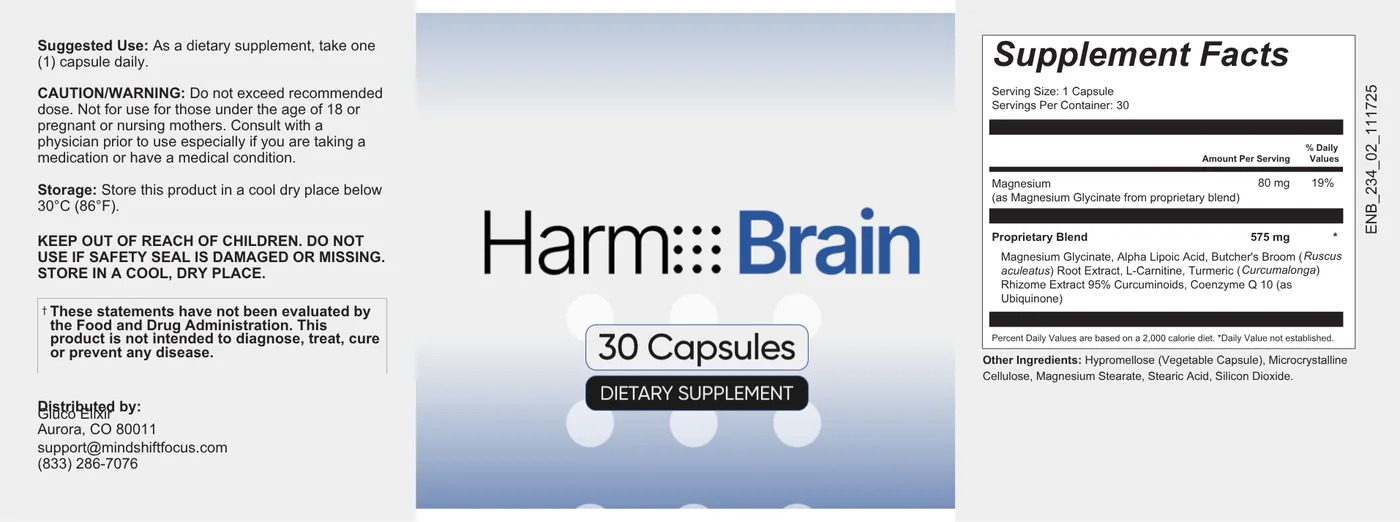
The Harmo Brain label panel The Supplement Facts box on the right carries the only two amounts: the 80 mg magnesium line and the 575 mg blend line, with the six names beneath it, magnesium glycinate first and CoQ10 last.
What the order of the names tells you
Under 21 CFR 101.36, the other ingredients in a proprietary blend are declared in descending order of weight, so alpha lipoic acid, butcher’s broom, L-carnitine, turmeric extract and CoQ10 appear heaviest to lightest. The magnesium glycinate’s share comes from arithmetic, not from its place in the list: 80 mg of magnesium takes about 568 mg of the compound.
The label arithmetic, worked once
Magnesium glycinate is about 14.1% magnesium by weight, so 80 mg of magnesium takes about 568 mg of the compound. If the glycinate is the fully reacted form, that leaves about 7 mg of the 575 mg blend for alpha lipoic acid, butcher’s broom, L-carnitine, turmeric extract and CoQ10 together. A buffered grade carries more magnesium per milligram and would leave more room; the label does not say which grade is used, and no other amount is printed. The label also names the same mineral twice over: the supplier’s artwork counts 7 ingredients because magnesium and magnesium glycinate each get a tile, while the panel lists 6 materials. Magnesium glycinate is the compound, and magnesium is the mineral it delivers.
In practice, magnesium is the ingredient you can size exactly. The other five are there in the amounts the formula sets, and the label gives them as one combined weight. The working uses PubChem’s molecular weight for magnesium glycinate (PubChem CID 84645); the 575 mg blend explainer goes through it step by step.
Studies beside the label
What studies used, beside what the Harmo Brain label prints
Research on these ingredients tested one ingredient at a time, often in another form and sometimes in people with a diagnosis. The table keeps those amounts in a column of their own.
Harmo Brain ingredients: research amounts and label amounts
Ingredient
What studies used
What the label prints
Magnesium (as glycinate)
Adult RDAs of 310 to 420 mg a day from all sources; upper limit for supplemental magnesium 350 mg a day (NIH ODS) (source)
80 mg magnesium, 19% of the Daily Value
Alpha lipoic acid
600 mg a day given intravenously for 3 weeks in the diabetic-neuropathy meta-analysis; 200 to 1,800 mg a day in the glucose studies the Linus Pauling Institute summarises (source)
Inside the 575 mg blend, listed second
Butcher’s broom root extract
Taken for 12 weeks in a placebo-controlled trial in chronic venous insufficiency; 150 mg of root extract per capsule in the Cyclo 3 Fort combination (source)
Inside the 575 mg blend, listed third
L-carnitine
The memory trials used a different form, acetyl-L-carnitine, at 1.5 to 3.0 g a day for 3 to 12 months, in adults with mild cognitive impairment or mild Alzheimer’s disease (source)
Inside the 575 mg blend, listed fourth
Turmeric extract, 95% curcuminoids
90 mg of a high-absorption curcumin twice a day for 18 months; 400 mg of solid lipid curcumin for 4 weeks (source)
Inside the 575 mg blend, listed fifth
Coenzyme Q10 (ubiquinone)
Absorption is slow: a blood peak about 6 hours after a dose and a half-life of about 33 hours (source)
Inside the 575 mg blend, listed sixth
Middle column: the studies, in their own populations. Right column: the label.
The capsule itself
The other Harmo Brain ingredients: the shell and the flow agents
The five other ingredients in a Harmo Brain capsule
Ingredient
What it is
Why it is in the capsule
Hypromellose (vegetable capsule)
A cellulose derived from plants
The plant-based shell that holds the powder
Microcrystalline cellulose
Purified plant cellulose
A filler that brings every capsule to the same fill
Magnesium stearate
The magnesium salt of stearic acid
A flow agent that stops the powder sticking to the filling machine
Stearic acid
A fatty acid found in many foods
A lubricant during encapsulation
Silicon dioxide
Silica
An anti-caking agent that keeps the powder free-flowing
None of the five is an active ingredient.
Questions
Harmo Brain ingredient questions
How much magnesium is in Harmo Brain?
80 mg a capsule, 19% of the Daily Value, supplied as magnesium glycinate from inside the blend. At one capsule a day that is 80 mg a day, under the 350 mg daily upper limit NIH sets for magnesium from supplements.
Does Harmo Brain contain caffeine or other stimulants?
No caffeine or other stimulant appears on the label. The six materials are a mineral, three nutrients involved in cell energy and two plant extracts.
Is Harmo Brain suitable for vegetarians?
The capsule shell is hypromellose, a vegetable capsule, and the supplier’s artwork carries a vegetarian roundel. If you avoid animal products strictly, ask order support on +1 (302) 200-3480 about the source of the magnesium stearate and stearic acid, which can come from plant or animal fats.
Is there gluten or dairy in Harmo Brain?
Neither appears on the label, and the supplier’s artwork carries dairy-free and gluten-free roundels. Those are the supplier’s own statements; the testing and quality page sets out what each seal can and cannot prove.
Who writes this
How this Harmo Brain ingredients page is written
Four commitments a careful reader can check in ten minutes:
The bottle is the source. The ingredient names, the two printed amounts,
the capsule count, the directions and the caution come from the Harmo Brain label and
the supplier’s artwork, read on 22 September 2026.
Research amounts live in a column of their own, headed “What studies
used”, beside the column that says what the label prints. No sentence moves a
number from one to the other.
Sources are cited against their own population. Where a trial was run in
people with a diagnosis, the sentence says so.
Corrections change the date. Write to
[email protected] and the review date moves forward.
We earn when you buy. Harmobraines is the USA Authorized Harmo Brain Retailer and this website makes money on
orders placed through it. That is why the blend arithmetic, the four-star reviews
and the medicine list are printed here in full. Order support on
+1 (302) 200-3480 handles tracking, changes and refunds; orders go
through the checkout only.
Written and reviewed by the Harmobraines Editorial Desk
Every page, every journal post, the bottle facts and the ingredients go through review by Dr. Harald Hampel, MD, PhD before they ship. We write these pages from the printed Harmo Brain label and its Supplement Facts panel,
the supplier’s artwork, this desk’s order records and the published
research on each named ingredient. The label prints two amounts, 80 mg of magnesium
and a 575 mg blend, and research doses are kept in a column of their own so the two
are never read as one fact. Corrections are made on the page and the review date
moves forward. Write to [email protected]. Last reviewed
September 2026.
Sources
Sources for the Harmo Brain ingredients page
NIH Office of Dietary Supplements. Magnesium: Fact Sheet for Health Professionals. Updated January 6, 2026. ods.od.nih.gov
Chen F, Wang J, Cheng Y, et al. Magnesium and Cognitive Health in Adults: A Systematic Review and Meta-Analysis. Adv Nutr. 2024;15(8):100272. PMID 39009081. pubmed.ncbi.nlm.nih.gov
Schuette SA, Lashner BA, Janghorbani M. Bioavailability of magnesium diglycinate vs magnesium oxide in patients with ileal resection. JPEN J Parenter Enteral Nutr. 1994;18(5):430-5. PMID 7815675. pubmed.ncbi.nlm.nih.gov
National Library of Medicine. PubChem Compound Summary: Magnesium Glycinate (CID 84645), C4H8MgN2O4, molecular weight 172.42 g/mol. pubchem.ncbi.nlm.nih.gov
21 CFR 101.36, Nutrition labeling of dietary supplements, paragraph (c)(2). Legal Information Institute, Cornell Law School. www.law.cornell.edu
Linus Pauling Institute, Oregon State University. Lipoic Acid. Micronutrient Information Center. lpi.oregonstate.edu
Shay KP, Moreau RF, Smith EJ, et al. Alpha-lipoic acid as a dietary supplement: molecular mechanisms and therapeutic potential. Biochim Biophys Acta. 2009;1790(10):1149-60. PMID 19664690. pubmed.ncbi.nlm.nih.gov
Mijnhout GS, Kollen BJ, Alkhalaf A, et al. Alpha lipoic acid for symptomatic peripheral neuropathy in patients with diabetes: a meta-analysis of randomized controlled trials. Int J Endocrinol. 2012;2012:456279. PMID 22331979. pubmed.ncbi.nlm.nih.gov
Vanscheidt W, Jost V, Wolna P, et al. Efficacy and safety of a Butcher's broom preparation (Ruscus aculeatus L. extract) compared to placebo in patients suffering from chronic venous insufficiency. Arzneimittelforschung. 2002;52(4):243-50. PMID 12040966. pubmed.ncbi.nlm.nih.gov
Boyle P, Diehm C, Robertson C. Meta-analysis of clinical trials of Cyclo 3 Fort in the treatment of chronic venous insufficiency. Int Angiol. 2003;22(3):250-62. PMID 14612852. pubmed.ncbi.nlm.nih.gov
European Medicines Agency. Rusci rhizoma (butcher's broom): herbal medicinal product, therapeutic area circulatory disorders. www.ema.europa.eu
NIH Office of Dietary Supplements. Carnitine: Fact Sheet for Health Professionals. ods.od.nih.gov
Montgomery SA, Thal LJ, Amrein R. Meta-analysis of double blind randomized controlled clinical trials of acetyl-L-carnitine versus placebo in the treatment of mild cognitive impairment and mild Alzheimer's disease. Int Clin Psychopharmacol. 2003;18(2):61-71. PMID 12598816. pubmed.ncbi.nlm.nih.gov
Wang W, Pan D, Liu Q, et al. L-Carnitine in the Treatment of Psychiatric and Neurological Manifestations: A Systematic Review. Nutrients. 2024;16(8). PMID 38674921. pubmed.ncbi.nlm.nih.gov
National Center for Complementary and Integrative Health. Turmeric: Usefulness and Safety. www.nccih.nih.gov
Small GW, Siddarth P, Li Z, et al. Memory and Brain Amyloid and Tau Effects of a Bioavailable Form of Curcumin in Non-Demented Adults: A Double-Blind, Placebo-Controlled 18-Month Trial. Am J Geriatr Psychiatry. 2018;26(3):266-277. PMID 29246725. pubmed.ncbi.nlm.nih.gov
National Center for Complementary and Integrative Health. Coenzyme Q10. www.nccih.nih.gov
Hernández-Camacho JD, Bernier M, López-Lluch G, Navas P. Coenzyme Q10 Supplementation in Aging and Disease. Front Physiol. 2018;9:44. PMID 29459830. pubmed.ncbi.nlm.nih.gov
National Center for Complementary and Integrative Health. 7 Things To Know About Dietary Supplements for Cognitive Function, Dementia, and Alzheimer's Disease. www.nccih.nih.gov
The six-bottle pack: 180 capsules, a 180-day supply at one a day.
Official website
Order Harmo Brain on the official website
One capsule a day, 30 to a bottle: 80 mg of magnesium as glycinate inside a 575 mg blend of six named materials, with 60 days from purchase to change your mind.
Packs of 2, 3 or 6 bottles, priced at checkout · 60 days from purchase to change your mind