Mineral
Magnesium glycinate
80 mg magnesium · 19% DV
An essential mineral, carried as a glycine chelate
A focus supplement label is read in four passes: the Supplement Facts panel for what is declared and how much, the blend for what is listed but not measured, the form of each ingredient, and the caution for who should not take it. This guide walks through all four using the Harmo Brain label as the worked example.
Then it sets each ingredient against what published research actually used.
Reading a label takes ten minutes the first time and two minutes after that.
The panel is the one part of the bottle written to a federal format.
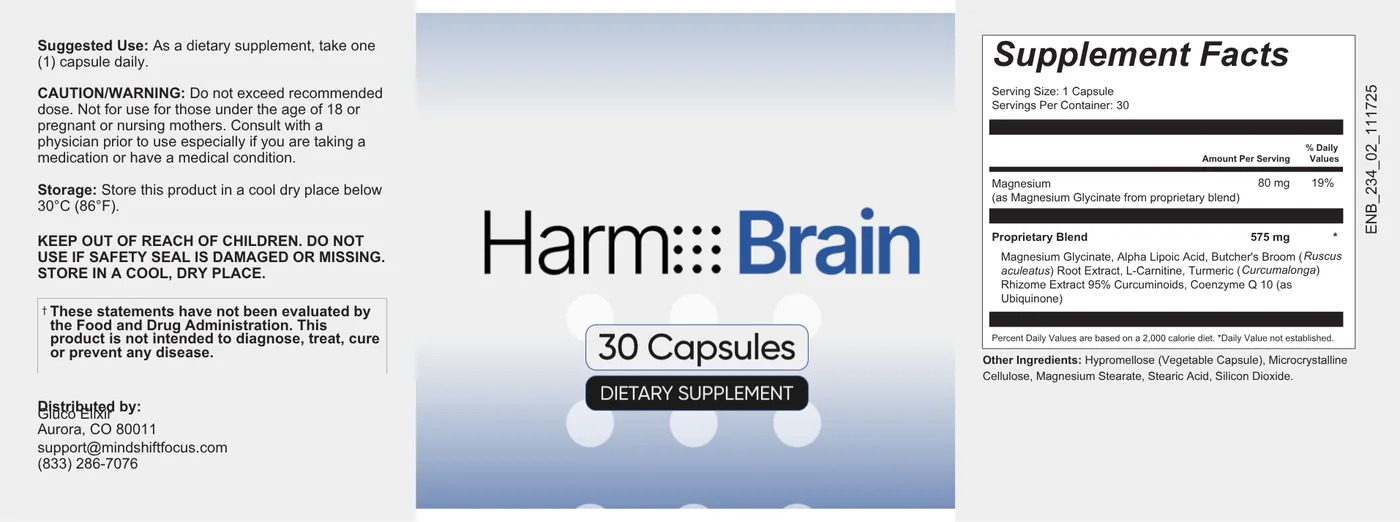
Under 21 CFR 101.36, a supplement label carries a Supplement Facts panel in a fixed format. Five things on it do most of the work for a buyer:
One capsule a serving, 30 servings. Magnesium, 80 mg, 19% of the Daily Value, from the glycinate in a 575 mg blend of six named materials. Five other ingredients, starting with a hypromellose capsule.
Four steps, then the arithmetic worked through once.
The blend’s weight is printed beside its name: here, 575 mg.
Parts with no Daily Value are listed heaviest first. A nutrient with a Daily Value is sized by its amount, not its place.
A part with its own line and amount can be sized. Here, the magnesium from the glycinate is declared: 80 mg.
Work out how much of the total the declared part must take, and what that leaves for everything else.
Magnesium glycinate is about 14.1% magnesium by weight, so 80 mg of magnesium takes about 568 mg of the compound. If the glycinate is the fully reacted form, that leaves about 7 mg of the 575 mg blend for alpha lipoic acid, butcher’s broom, L-carnitine, turmeric extract and CoQ10 together. A buffered grade carries more magnesium per milligram and would leave more room; the label does not say which grade is used, and no other amount is printed.
Under 21 CFR 101.36, the other ingredients in a proprietary blend are declared in descending order of weight, so alpha lipoic acid, butcher’s broom, L-carnitine, turmeric extract and CoQ10 appear heaviest to lightest. The magnesium glycinate’s share comes from arithmetic, not from its place in the list: 80 mg of magnesium takes about 568 mg of the compound.
The one constant behind it is the molecular weight of magnesium glycinate, 172.42 g/mol (PubChem), of which magnesium is 14.1%.
Five materials, five cases where the research used something slightly different.
| On this label | What the research used | Why it matters |
|---|---|---|
| L-carnitine | Acetyl-L-carnitine, 1.5 to 3.0 g a day for 3 to 12 months, in adults with mild cognitive impairment or mild Alzheimer’s disease (Montgomery 2003) | A different form, in a diagnosed population, at gram doses. |
| Turmeric extract, 95% curcuminoids | Specially absorbed curcumin: 90 mg twice a day for 18 months (Small 2018); 400 mg of solid lipid curcumin for 4 weeks (Cox 2015) | Ordinary curcumin is poorly absorbed (Lopresti 2018). |
| Magnesium glycinate | Magnesium diglycinate against magnesium oxide in patients with ileal resection (Schuette 1994) | A bioavailability comparison in a specific patient group, not a focus study. |
| Alpha lipoic acid | 600 mg a day given intravenously for 3 weeks, in diabetic neuropathy (Mijnhout 2012) | A different route, a different condition. |
| Coenzyme Q10 as ubiquinone | Absorption studies: a blood peak about 6 hours after a dose and a half-life of about 33 hours (Bhagavan 2006) | An absorption study, not a focus study. |
Read the form on the label first, then look for research on that form.
The one ingredient on this label with its own printed amount.
Name, what the panel prints for it, and its role, in label order.
80 mg magnesium · 19% DV
An essential mineral, carried as a glycine chelate
Inside the 575 mg blend
A cofactor of the mitochondrial enzymes that turn fuel into energy
Inside the 575 mg blend
A venotonic herb, the circulatory half of the formula
Inside the 575 mg blend
Carries fatty acids into mitochondria to be burned for energy
Inside the 575 mg blend · 95% curcuminoids
Curcuminoids, the yellow compounds studied for memory and attention
Inside the 575 mg blend · as ubiquinone
Part of the mitochondrial electron transport chain
Two columns that are never merged into one sentence.
| Ingredient | What studies used | What the label prints |
|---|---|---|
| Magnesium (as glycinate) | Adult RDAs of 310 to 420 mg a day from all sources; upper limit for supplemental magnesium 350 mg a day (NIH ODS) (source) | 80 mg magnesium, 19% of the Daily Value |
| Alpha lipoic acid | 600 mg a day given intravenously for 3 weeks in the diabetic-neuropathy meta-analysis; 200 to 1,800 mg a day in the glucose studies the Linus Pauling Institute summarises (source) | Inside the 575 mg blend, listed second |
| Butcher’s broom root extract | Taken for 12 weeks in a placebo-controlled trial in chronic venous insufficiency; 150 mg of root extract per capsule in the Cyclo 3 Fort combination (source) | Inside the 575 mg blend, listed third |
| L-carnitine | The memory trials used a different form, acetyl-L-carnitine, at 1.5 to 3.0 g a day for 3 to 12 months, in adults with mild cognitive impairment or mild Alzheimer’s disease (source) | Inside the 575 mg blend, listed fourth |
| Turmeric extract, 95% curcuminoids | 90 mg of a high-absorption curcumin twice a day for 18 months; 400 mg of solid lipid curcumin for 4 weeks (source) | Inside the 575 mg blend, listed fifth |
| Coenzyme Q10 (ubiquinone) | Absorption is slow: a blood peak about 6 hours after a dose and a half-life of about 33 hours (source) | Inside the 575 mg blend, listed sixth |
The middle column describes studies. The right-hand column is the label. Neither is a recommendation.
The label’s caution, then what it means ingredient by ingredient.
Do not exceed recommended dose. Not for use for those under the age of 18 or pregnant or nursing mothers. Consult with a physician prior to use especially if you are taking a medication or have a medical condition.
| Ingredient | Medicine | What is known |
|---|---|---|
| Magnesium | Oral bisphosphonates; tetracycline and quinolone antibiotics | Magnesium can bind them in the gut; ODS lists these interactions. (source) |
| Alpha lipoic acid | Insulin and other glucose-lowering medicine | The Linus Pauling Institute notes a risk of low blood sugar with insulin or oral diabetes medicine; case reports also tie it to rare insulin autoimmune syndrome. (source) |
| CoQ10 | Warfarin; insulin | NCCIH: CoQ10 may interact with the blood thinner warfarin and with insulin. (source) |
| L-carnitine | Acenocoumarol and similar blood thinners | A published case report describes a stronger anticoagulant effect. (source) |
| Butcher’s broom | Blood-pressure treatment | An alpha-adrenergic, vein-constricting herb; raise it if blood pressure is treated. (source) |
| Turmeric extract | Any medicine that affects the liver | NCCIH warns that highly bioavailable curcumin formulations may harm the liver. (source) |
Four kinds of evidence, from weakest to strongest for a buyer.
Useful for mechanism, never for dosing a person. Example: acetyl-L-carnitine and lipoic acid fed to old rats (Hagen 2002).
Useful for dose, duration and safety in that group. Example: the acetyl-L-carnitine trials in mild cognitive impairment.
Closer to a buyer, but check the form: the curcumin trials used specially absorbed preparations.
The strongest summary when trials exist. Example: a 2024 review found too few trials to judge magnesium supplements for cognition (Chen 2024).
The habits the National Institute on Aging lists for cognitive health.
NIA names high blood pressure in midlife as a risk for cognitive decline later in life.
At least 150 minutes of activity a week, the federal guideline NIA cites.
NIA lists enough sleep, generally seven to nine hours a night.
Social activities and community programs are on NIA’s list.
The National Institute on Aging recommends no vitamin or supplement for preventing cognitive decline, and NCCIH finds direct evidence that supplements prevent dementia lacking. A capsule sits on top of these habits, never in place of them.
Any ingredient printed with its own amount: the only part of a label you can set against published research.
It is a trade-off. The label still gives the total and ranks the unmeasured parts by weight, but not the amount of each one, so fewer comparisons are possible.
It is a labelling reference. For magnesium the Daily Value is 420 mg, so 80 mg is 19%; the adult allowances run 310 to 420 mg a day from all sources (NIH ODS).
Four commitments a careful reader can check in ten minutes:
We earn when you buy. Harmobraines is the USA Authorized Harmo Brain Retailer and this website makes money on orders placed through it. That is why the blend arithmetic, the four-star reviews and the medicine list are printed here in full. Order support on +1 (302) 200-3480 handles tracking, changes and refunds; orders go through the checkout only.
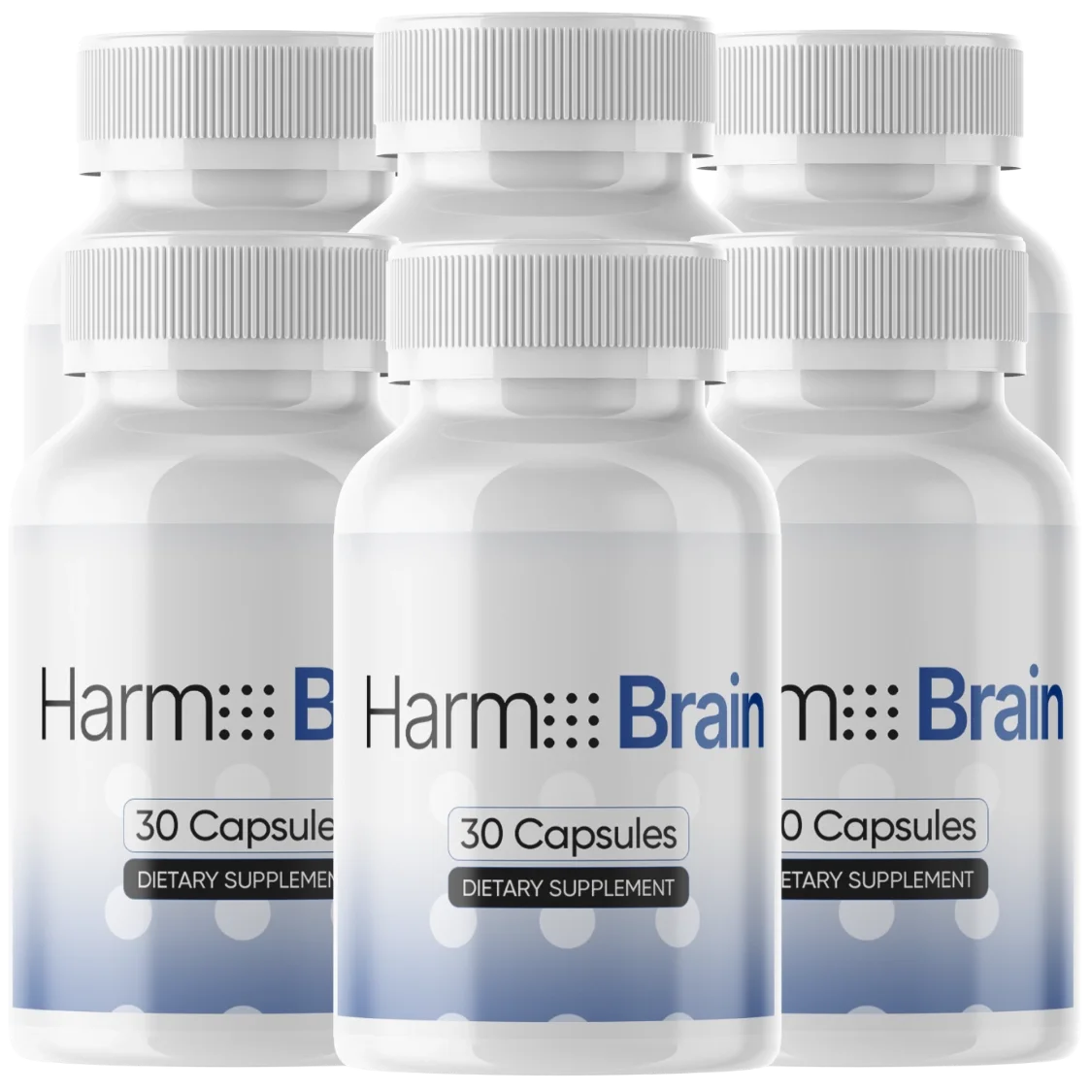
One capsule a day, 30 to a bottle: 80 mg of magnesium as glycinate inside a 575 mg blend of six named materials. Packs of 2, 3 or 6 are priced at checkout, with 60 days from purchase to change your mind.
Packs of 2, 3 or 6 bottles, priced at checkout · 60 days from purchase to change your mind
One capsule a day · 30 per bottle · lot HAR-26/HA-4569