What a 575 mg Blend Can Hold When 80 mg of It Is Magnesium
The Harmo Brain label prints two numbers: 80 mg of magnesium and a 575 mg proprietary blend. Put them beside one published constant and they say more about the capsule than any line of marketing can.
- Two amounts. The label declares magnesium at 80 mg and the blend at 575 mg; the magnesium comes from magnesium glycinate inside the blend.
- 14.1%. Magnesium’s share of magnesium glycinate by weight, from the compound’s molecular weight of 172.42 g/mol.
- About 568 mg. The fully reacted glycinate needed to carry 80 mg of magnesium.
- About 7 mg. What that would leave for the other five materials, unless a buffered grade is used.
Two numbers on one panel
Most focus supplements with a proprietary blend print one number: the total. The Harmo Brain panel prints two, and the second one is what makes this article possible. Under Supplement Facts it reads: magnesium, 80 mg, 19% of the Daily Value, “as Magnesium Glycinate from proprietary blend”. Below it sits the proprietary blend itself, 575 mg, with six named materials.
The words “from proprietary blend” matter. They say the magnesium is not an extra ingredient added on top of the 575 mg. It is carried by the first material listed inside the blend, magnesium glycinate, and it is counted inside that 575 mg total.
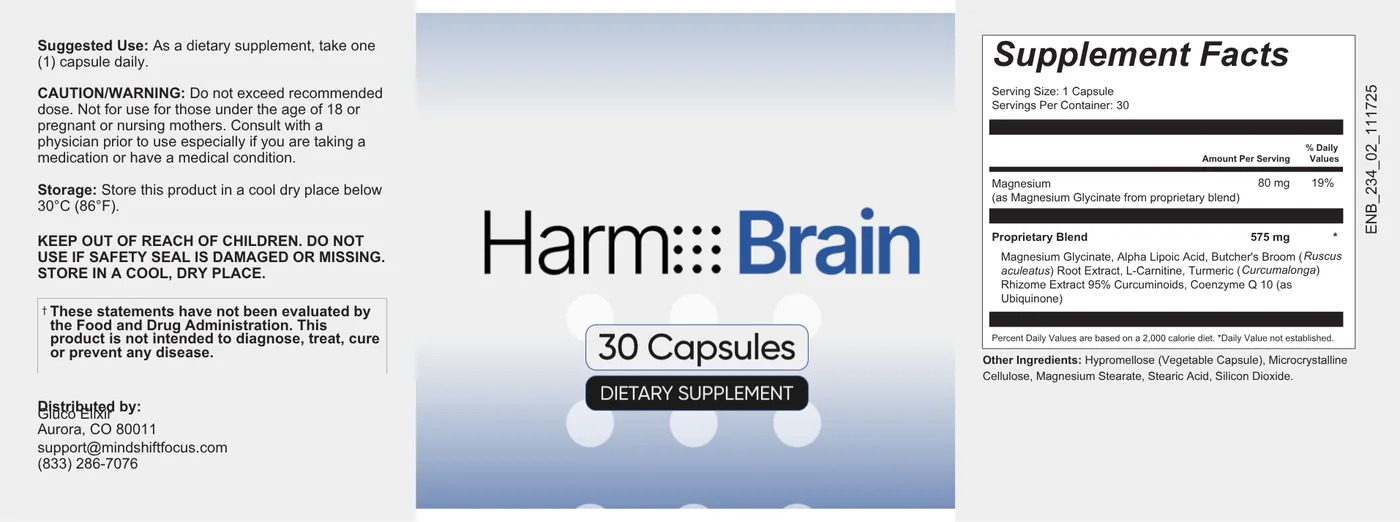
You can read every line of it on the Supplement Facts page, where the panel is set in text as well as shown as artwork.
What the label order tells you
A blend does not have to state how much of each part it contains, but it does have to state an order. Under 21 CFR 101.36, the blend’s “other dietary ingredients”, the ones with no Daily Value, are listed in descending order of predominance by weight: heaviest first, lightest last. A nutrient that does have a Daily Value, such as magnesium, is declared by its own amount instead. On this label the list reads:
- Magnesium Glycinate
- Alpha Lipoic Acid
- Butcher’s Broom (Ruscus aculeatus) Root Extract
- L-Carnitine
- Turmeric (Curcuma longa) Rhizome Extract 95% Curcuminoids
- Coenzyme Q10 (as Ubiquinone)
So the five materials after the glycinate run from alpha lipoic acid, the heaviest of them, down to coenzyme Q10, the lightest. That part of the order is a legal statement, not a design choice.
The glycinate at the top is a different case. Its magnesium is declared as 80 mg, so the rule does not rank it by its place in the list, and being named first proves nothing about its weight on its own. Its share comes from arithmetic instead, and the next section shows that the arithmetic puts it at almost the whole blend.
The arithmetic, step by step
The only outside number needed is the weight of the compound. PubChem lists magnesium glycinate (CID 84645, C4H8MgN2O4) at 172.42 g/mol. Each molecule carries one magnesium atom, which weighs 24.3. From there it is three lines:
- Magnesium’s share of the compound: 24.3 ÷ 172.42 = 0.141, or 14.1%.
- Compound needed for 80 mg of magnesium: 80 ÷ 0.141 = about 568 mg.
- What is left of the blend: 575 − 568 = about 7 mg.
Magnesium glycinate is about 14.1% magnesium by weight, so 80 mg of magnesium takes about 568 mg of the compound. If the glycinate is the fully reacted form, that leaves about 7 mg of the 575 mg blend for alpha lipoic acid, butcher’s broom, L-carnitine, turmeric extract and CoQ10 together. A buffered grade carries more magnesium per milligram and would leave more room; the label does not say which grade is used, and no other amount is printed.
Seven milligrams is about 1% of the blend, shared between five named materials. That is what the numbers say if the glycinate is the pure, fully reacted compound. The next section is about why that “if” matters.
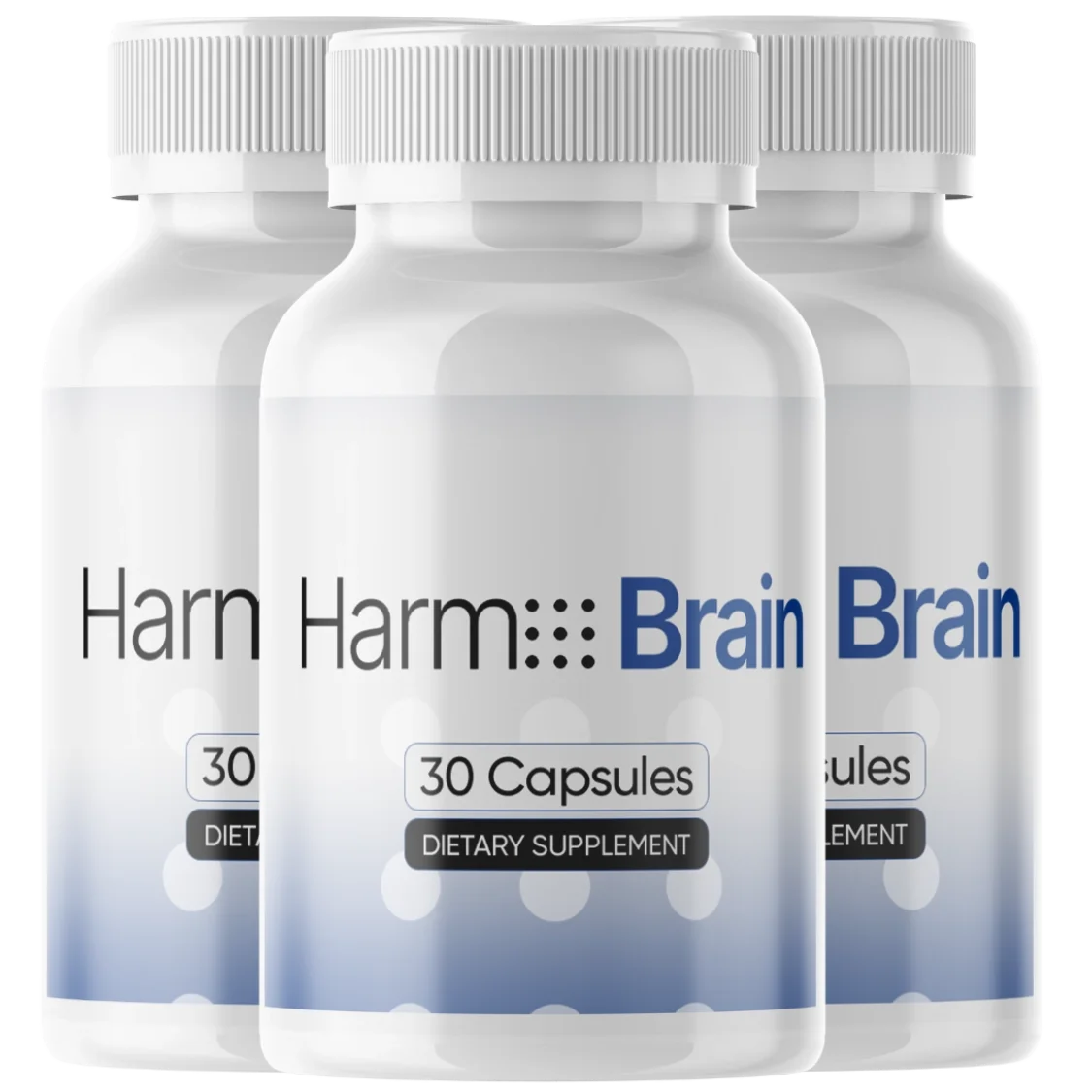
Harmo Brain, on the official website
One capsule a day, 30 to a bottle: 80 mg of magnesium as glycinate inside a 575 mg blend of six named materials. Packs of 2, 3 or 6 are priced at checkout, with 60 days from purchase to change your mind.
Order Harmo BrainWhy the grade of glycinate matters
Magnesium glycinate is sold in more than one grade. A fully reacted grade is the chelate alone, at 14.1% magnesium. A buffered grade is mixed with another magnesium compound that carries more magnesium per milligram, so less of it is needed to reach 80 mg, and more of the 575 mg is left for everything else.
The label does not say which grade is used. So the honest way to show the question is as a range. The table below does the same arithmetic at five different magnesium shares. Only the first is a published figure; the others are illustrations of how the room changes.
| Magnesium share | Needed for 80 mg | Left in the blend |
|---|---|---|
| 14.1% (fully reacted, PubChem) | About 568 mg | About 7 mg |
| 16% (illustration) | 500 mg | 75 mg |
| 18% (illustration) | About 444 mg | About 131 mg |
| 20% (illustration) | 400 mg | 175 mg |
| 25% (illustration) | 320 mg | 255 mg |
Arithmetic only. The label names magnesium glycinate and no grade; the illustrative rows show how the answer moves, not what is in the capsule.
Even at the generous end, the other five materials share a few hundred milligrams at most. The arithmetic cannot say how that room is divided between them; the order on the label says only that alpha lipoic acid has the largest share of it and CoQ10 the smallest.
What studied amounts look like beside it
Published research on these ingredients used amounts that sit in a different column from anything in this capsule. They are listed here for scale, not as targets, and each is named with the people it was studied in.
- Alpha lipoic acid: 600 mg a day, given intravenously for three weeks, in adults with diabetic peripheral neuropathy (Mijnhout 2012).
- Butcher’s broom: 150 mg of root extract per capsule in the Cyclo 3 Fort combination, in people with chronic venous insufficiency (Boyle 2003).
- Acetyl-L-carnitine, a different form from the label’s L-carnitine: 1.5 to 3.0 g a day in adults with mild cognitive impairment or mild Alzheimer’s disease (Montgomery 2003).
None of those is a dose this capsule is trying to match, and none of those studies tested it. What the list shows is the gap between a trial dose and a share of a blend, which is worth knowing before judging any multi-ingredient focus formula by its ingredient names. The ingredients page sets every research amount beside what the label prints, in two columns that are never merged.
What the magnesium figure does tell you
The arithmetic is a limit on the other five. It is also the reason the magnesium figure is solid: 80 mg is declared, it carries a Daily Value of 19%, and it sits well under the 350 mg a day that NIH ODS gives as the adult upper limit for magnesium from supplements.
Magnesium glycinate is also, by that same arithmetic, the largest part of the blend by weight. A buyer who wants to know what the capsule reliably delivers every day has one clear answer: 80 mg of magnesium, as glycinate. The companion article on magnesium glycinate at 80 mg sets that figure against the Daily Value, the adult allowances and the upper limit.
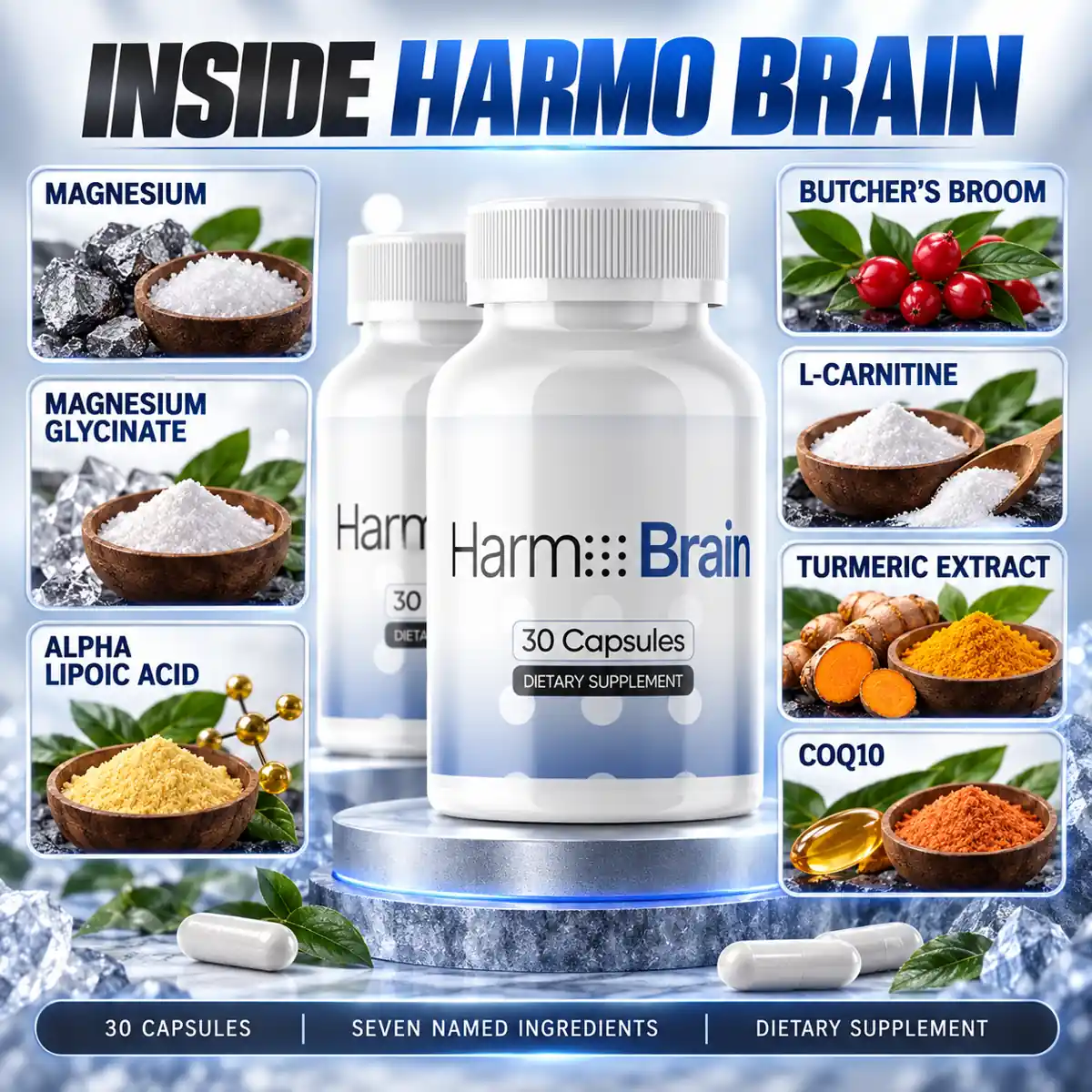
What the arithmetic cannot tell you
- How the room is divided. The order says alpha lipoic acid has the largest share of what is left and CoQ10 the smallest, and nothing more.
- Which grade of glycinate is used. A certificate of analysis for the batch would answer it in one line; the label leaves it open.
- How the capsule feels to take. That is what a routine of several weeks, and the 60-day window, are for.
- Whether it suits your medicines. That is a question for whoever prescribes them, with the label in hand.
Two numbers and a molecular weight go a long way. They stop at the edge of the blend, which is exactly where a careful buyer stops assuming too.
How to use this when you buy
- Read the panel, not the artwork. The panel is the document with amounts.
- Do the blend arithmetic on any label that declares one part of a blend.
- Treat the declared amount as the product’s one checkable dose, and the rest as supporting ingredients whose share you cannot size.
- Judge the routine over weeks: most of this desk’s buyers who report a change put it at three to six weeks.
- Keep the purchase inside the 60-day refund window, which the guarantee page explains.
Packs of 2, 3 or 6 bottles are priced on the checkout, and the pricing page sets them side by side.
A note on what this is. Harmo Brain is a dietary supplement, not a medicine. Nothing in this article describes it as a treatment for dementia, Alzheimer’s disease, mild cognitive impairment or any other condition, and no vitamin or supplement is recommended for preventing cognitive decline. A change in memory or thinking that worries you is a reason to be assessed by a clinician, not a reason to start a capsule.
Sources cited in this article
- NIH Office of Dietary Supplements. Magnesium: Fact Sheet for Health Professionals. Updated January 6, 2026. ods.od.nih.gov
- National Library of Medicine. PubChem Compound Summary: Magnesium Glycinate (CID 84645), C4H8MgN2O4, molecular weight 172.42 g/mol. pubchem.ncbi.nlm.nih.gov
- 21 CFR 101.36, Nutrition labeling of dietary supplements, paragraph (c)(2). Legal Information Institute, Cornell Law School. www.law.cornell.edu
- Mijnhout GS, Kollen BJ, Alkhalaf A, et al. Alpha lipoic acid for symptomatic peripheral neuropathy in patients with diabetes: a meta-analysis of randomized controlled trials. Int J Endocrinol. 2012;2012:456279. PMID 22331979. pubmed.ncbi.nlm.nih.gov
- Boyle P, Diehm C, Robertson C. Meta-analysis of clinical trials of Cyclo 3 Fort in the treatment of chronic venous insufficiency. Int Angiol. 2003;22(3):250-62. PMID 14612852. pubmed.ncbi.nlm.nih.gov
- Montgomery SA, Thal LJ, Amrein R. Meta-analysis of double blind randomized controlled clinical trials of acetyl-L-carnitine versus placebo in the treatment of mild cognitive impairment and mild Alzheimer's disease. Int Clin Psychopharmacol. 2003;18(2):61-71. PMID 12598816. pubmed.ncbi.nlm.nih.gov
More about Harmo Brain
Order Harmo Brain on the official website
One capsule a day, 30 to a bottle: 80 mg of magnesium as glycinate inside a 575 mg blend of six named materials. Packs of 2, 3 or 6 are priced at checkout, with 60 days from purchase to change your mind.
Packs of 2, 3 or 6 bottles, priced at checkout · 60 days from purchase to change your mind
One capsule a day · 30 per bottle · lot HAR-26/HA-4569